
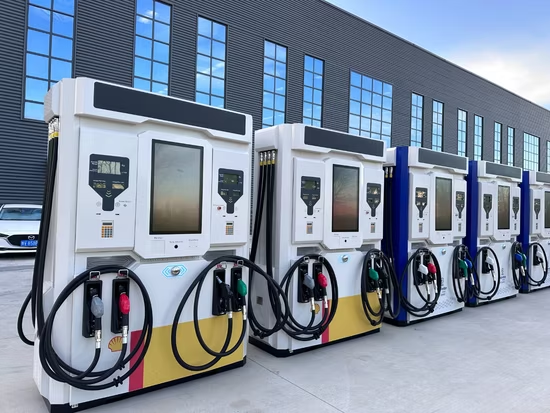
Fuel Dispenser Market Forecast 2025–2035 | Dispenser Types | End-Use Applications | Regional Breakdown
March 2026 | Source: MRFR Fuel Dispenser Market Report
| Key Takeaways
• Global market valued at USD 2,479.5 million in 2024 — projected to reach USD 4,619.77 million by 2035. • CAGR of 5.8% from 2025–2035, driven by vehicle fleet growth, regulatory compliance, and smart fueling tech. • Digital dispensers with contactless payment and fleet management integration are the new market standard. • Asia-Pacific and Middle East lead new fuel station construction; North America and Europe focus on upgrades. • Multi-fuel dispensers supporting CNG, LNG, hydrogen, and EV charging are the key future growth segment. |
Fuel dispensers are the last mile of the global energy supply chain — the point where fuel reaches vehicles, machinery, and fleets. What was once a simple mechanical pump is now a connected digital system handling payments, fleet data, vapor recovery, and increasingly, alternative fuels. As vehicle ownership climbs in emerging markets and energy transition accelerates in developed ones, the fuel dispenser market is evolving rapidly on both ends of the spectrum.
Market size and forecast (2024–2035)
The global fuel dispenser market was valued at USD 2,479.5 million in 2024 and is projected to reach USD 4,619.77 million by 2035 at a CAGR of 5.8%, per MRFR analysis. Growth is underpinned by new fuel station construction in Asia-Pacific and the Middle East, regulatory-driven replacement cycles in developed markets, and accelerating demand for smart and multi-fuel dispensing systems globally.
Types of fuel dispensers — which fits your operation?
Selecting the right dispenser type determines compliance, throughput, and long-term ROI. Here is a direct comparison across all major categories:
| Type | Key Features | Best For | End Users | Trend |
| Mechanical | Basic flow meter, manual calibration | Low-cost rural stations | Small retail stations | Declining |
| Electronic/Digital | Digital display, electronic flow meter, auto-calibration | Urban & highway retail stations | Retail, fleet, commercial | Dominant |
| Tokheim / Hybrid | Multi-product dispensing, blending capability | Premium retail & branded stations | Branded fuel retailers | Growing |
| Multi-Fuel | CNG, LNG, hydrogen, petrol/diesel in one unit | Future-ready stations | Fleet ops, green fuel hubs | Fastest growing |
| Bulk / Industrial | High-flow, durability-focused, fleet card integration | Private fleets, mining, aviation | Industrial, aviation, marine | Stable |
Key shift to note: Electronic and digital dispensers now dominate all new installations globally. Multi-fuel units — capable of dispensing CNG, LNG, hydrogen, and conventional fuels from a single island — represent the fastest-growing segment as fuel retailers invest in future-ready infrastructure.
End-use applications and key requirements
Retail fuel stations remain the largest segment by volume, but fleet, industrial, and aviation applications command the highest unit value per dispenser:
| End-Use Segment | Use Case | Key Requirement |
| Retail Fuel Stations | Daily consumer fueling — petrol, diesel, premium | Speed, payment integration, loyalty programs |
| Commercial Fleet | Fuel tracking for logistics, buses, rental vehicles | Fleet card support, volume accuracy, reporting |
| Industrial / Mining | On-site fueling for heavy machinery and equipment | High flow rate, durability, tamper-proof metering |
| Aviation | Jet fuel dispensing at airports and private airfields | Aviation-grade precision, safety certification |
| Marine / Ports | Marine fuel dispensing at harbours and ports | Saltwater resistance, spill containment |
| Agriculture | Diesel supply for tractors and farm equipment | Mobile or fixed units, basic metering |
What is driving fuel dispenser demand?
- Vehicle fleet expansion: Rising vehicle ownership in India, Southeast Asia, Africa, and Latin America directly increases the number of fueling infrastructure touchpoints required — each new fuel station needs 4–12 dispenser units on average.
- Regulatory replacement cycles: Governments mandate phased replacement of mechanical dispensers with electronic, tamper-proof, and vapor-recovery-compliant units. This creates recurring demand in mature markets independent of new station construction.
- Smart fueling technology: Contactless payments, fleet card integration, loyalty programme connectivity, and real-time inventory monitoring are now procurement requirements — not optional features — for fuel retail operators.
- Alternative fuel infrastructure: CNG, LNG, and hydrogen dispensing infrastructure is scaling rapidly in Europe, China, Japan, and South Korea. Multi-fuel dispenser manufacturers are the primary beneficiaries of this transition.
- Commercial fleet growth: Logistics, e-commerce delivery, and public transport fleet expansion — particularly in Asia-Pacific — is driving demand for private and semi-private fueling stations with high-capacity automated dispensers.
Regional market breakdown
Asia-Pacific leads new installation volume; North America and Europe are driven by smart upgrades and alternative fuel mandates.
| Region | Maturity | Key Drivers | Outlook |
| North America | Mature | Infrastructure upgrades, smart tech adoption, EMV compliance | Steady; digital & EV-ready dispenser upgrades |
| Europe | Mature | Environmental regulations, alternative fuel mandates, EU targets | Moderate; multi-fuel dispenser growth |
| Asia-Pacific | Rapidly growing | Vehicle ownership surge, new fuel station construction, urbanisation | Highest CAGR — largest new installation volume |
| Middle East & Africa | Expanding | Fuel retail network expansion, rising vehicle fleet, oil nations | Strong; significant greenfield opportunity |
| Latin America | Emerging | Highway network growth, commercial fleet expansion | Moderate; cost-sensitive market |
India spotlight: India’s fuel dispenser market is expanding on two fronts — rapid petrol station construction along national highways and expressways, and a government push for CNG and ethanol-blend dispensing infrastructure. The FAME scheme and city gas distribution network expansion are creating direct procurement demand for upgraded dispensing systems.
Competitive landscape
The fuel dispenser market is led by a small group of global specialists — Gilbarco Veeder-Root (Fortive), Wayne Fueling Systems (Dover), Tokheim, and Bennett Pump — who collectively dominate premium and mid-market segments. Chinese manufacturers including Sanki and Censtar are gaining share in cost-sensitive emerging markets. Competition centres on payment integration capability, alternative fuel readiness, regulatory certification breadth, and after-sales service network coverage. Modular, upgradeable designs are increasingly a decisive differentiator as operators seek to extend hardware lifecycles.
Outlook through 2035
The fuel dispenser market will be shaped by three converging forces: multi-energy dispensing hubs replacing single-fuel stations, AI-driven predictive maintenance and fuel management software becoming standard, and emerging market greenfield construction sustaining volume growth through the decade. Manufacturers that deliver certified, connected, and alternative-fuel-ready platforms will lead the market — while those anchored to mechanical or legacy digital hardware face accelerating obsolescence.
Related market reports
Market data sourced from Market Research Future (MRFR). Published March 2026. For custom research enquiries, contact MRFR here.