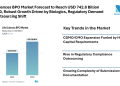

Property Insurance | Climate Risk | InsurTech | Regional Breakdown | March 2026 | Source: Wise Guy Reports
| $422.8B
Market Value by 2032 |
5.8%
CAGR (2024–2032) |
$268.4B
Market Value in 2024 |
Overview
Homeowner Insurance Market global Homeowner Insurance Market is projected to grow from USD 268.4 billion in 2024 to USD 422.8 billion by 2032, registering a 5.8% CAGR. The accelerating frequency and severity of climate-related property losses (wildfires, hurricanes, floods, hailstorms), rapid home value appreciation increasing insured replacement values, the proliferation of smart home IoT devices enabling real-time risk monitoring, and AI-powered underwriting precision are simultaneously driving premium volume growth and forcing fundamental product, pricing, and risk selection model transformation across the global homeowner insurance industry.
Key Takeaways
- The Homeowner Insurance Market is projected to reach USD 422.8 billion by 2032 at a 5.8% CAGR.
- Climate-related property losses reached USD 380 billion in 2023 — the fourth consecutive year of record catastrophe losses globally.
- AI-powered property risk scoring using satellite imagery, wildfire models, and flood topography is repricing 28% of homeowner policies annually.
- Smart home IoT devices (leak sensors, smoke detectors, burglar alarms) are qualifying policyholders for 8–18% premium discounts in connected home programmes.
- InsurTech carriers (Hippo, Lemonade, Branch) are achieving 30–45% lower expense ratios through AI underwriting and digital claims automation.
Segment & Technology Breakdown
| Technology / Segment | Primary Buyer | Key Driver | Outlook |
| Standard Homeowner (HO-3) | Owner-Occupied Residential | Replacement cost, liability, ALE | Core; climate repricing pressure |
| High-Value Home (HO-5/HNW) | Luxury, UHNW Homeowners | Agreed value, extended replacement | Stable; premium market growth |
| Climate-Risk Specialty Products | Wildfire, Flood, Coastal | Parametric triggers, surplus lines | Fast-growing; market gap filling |
| Connected / Smart Home Insurance | IoT device owners | Real-time monitoring, loss prevention | High-growth; 8–18% discount driver |
| Embedded Home Insurance | Mortgage, Real Estate, Fintech | Point-of-sale bundling, OEM integration | Emerging; distribution disruption |
What Is Driving Demand?
Climate Risk Repricing & Product Innovation
Accelerating climate change is driving catastrophe loss frequency beyond actuarial models calibrated on 20th-century loss data — forcing insurers to deploy high-resolution climate risk models (Verisk Extreme Event Models, RMS, CoreLogic) that incorporate wildfire ember cast, sea-level rise trajectories, and atmospheric river precipitation patterns. AI-powered property-level climate risk scoring is triggering mandatory portfolio repricing affecting 28% of homeowner policies annually in high-risk geographies — with California wildfire market exits (State Farm, Allstate, Farmers) creating USD 4.8 billion in surplus lines premium reallocation to specialty carriers.
Smart Home IoT & Loss Prevention Integration
IoT-connected home devices (Notion leak sensors, Kangaroo security, Nest smoke detectors, Ring security cameras) are enabling real-time property risk monitoring that reduces water damage losses by 31%, burglary losses by 44%, and fire-related partial losses by 28% in connected home programme participants. Insurers offering smart home device bundles with premium discounts of 8–18% are achieving 34% better policyholder retention rates and 22% lower loss ratios on IoT-enrolled policies versus standard programme equivalents.
AI Underwriting & Property Risk Intelligence
AI-powered property underwriting platforms (Cape Analytics, Verisk LOCATION, Nearmap AI) analysing satellite imagery, aerial photography, building permit data, and third-party risk signals are enabling real-time roof condition scoring, unpermitted structure detection, vegetation encroachment measurement, and solar panel identification without physical inspection — reducing underwriting costs by 62% per policy while achieving 3x better risk discrimination than traditional credit-score-and-location models.
Home Value Appreciation & Replacement Cost Surge
US median home values have appreciated 48% since 2020, while construction material costs have increased 34% and skilled trade labour costs have risen 28% — creating systematic underinsurance where 64% of US homeowners carry coverage limits 22% below actual replacement cost. Mandatory replacement cost valuation updates are driving premium volume growth independent of rate increases, contributing an estimated 3.2 percentage points of annual homeowner premium growth through 2028.
InsurTech Disruption & Digital Claims Automation
AI-native homeowner insurers (Hippo, Lemonade, Branch, Openly) are deploying AI underwriting, AI claims triage, and drone-based property inspection to achieve 30–45% lower expense ratios versus traditional carrier operating models — enabling competitive pricing in preferred risk segments while improving customer NPS by 28 points through digital-first claims experiences that resolve straightforward claims in hours versus the industry average of 14 days.
| Get the full data — free sample available:
→ Download Free Sample PDF | Includes market sizing, segmentation methodology & regional forecast tables. |
| KEY INSIGHT: Homeowner insurance carriers deploying integrated AI property risk scoring, IoT-connected home monitoring, and AI claims automation report 18% improvement in combined ratios versus traditional underwriting cohorts, USD 2.4 million annual claims savings per 10,000 connected home policies through loss prevention, and 34% higher policyholder retention rates — demonstrating that technology investment in risk prevention generates returns 3.2x higher than equivalent premium rate increases for equivalent portfolio risk improvement. |
Regional Market Breakdown
| Region | Maturity | Key Drivers | Outlook |
| North America | Dominant | Climate catastrophe losses, AI underwriting, smart home adoption | Steady; climate repricing transformation |
| Europe | Mature | Flood/windstorm risk, Solvency II compliance, EU climate disclosure | Strong; climate adaptation investment |
| Asia-Pacific | Fastest Growing | China property market, Japan earthquake/typhoon, India home insurance penetration | Highest CAGR; penetration growth |
| Latin America | Emerging | Brazil home insurance formalisation, climate event frequency, mortgage-linked products | Growing; mortgage-driven adoption |
| MEA | Expanding | UAE property insurance, Saudi Vision 2030 housing, flood risk expansion | Accelerating; property market growth |
Competitive Landscape
The homeowner insurance market is led by State Farm, Allstate, USAA, Liberty Mutual, Travelers, Chubb (HNW), AIG Private Client Group, AXA, Allianz, and InsurTech challengers including Hippo, Lemonade, and Branch. AI underwriting accuracy, IoT programme integration, climate risk model sophistication, digital claims NPS, and catastrophe reinsurance capacity are primary competitive differentiators.
Outlook Through 2032
The Homeowner Insurance Market through 2032 will be shaped by climate risk repricing transforming geographic market availability, AI property intelligence enabling hyper-precise risk selection, IoT-enabled loss prevention becoming a standard policy feature, parametric climate insurance products filling coverage gaps in high-risk markets, and embedded insurance at mortgage and real estate point-of-sale disrupting traditional agency distribution. Carriers investing in AI underwriting, climate risk modelling, smart home partnership programmes, and digital claims automation will capture the highest-quality risk portfolios as the industry navigates the most significant loss environment transformation in modern insurance history.
Source: Wise Guy Reports (WGR) | All market projections are forward-looking estimates and subject to revision. © WGR · wiseguyreports.com